
Medical Marijuana: A Look at the Pros and Cons
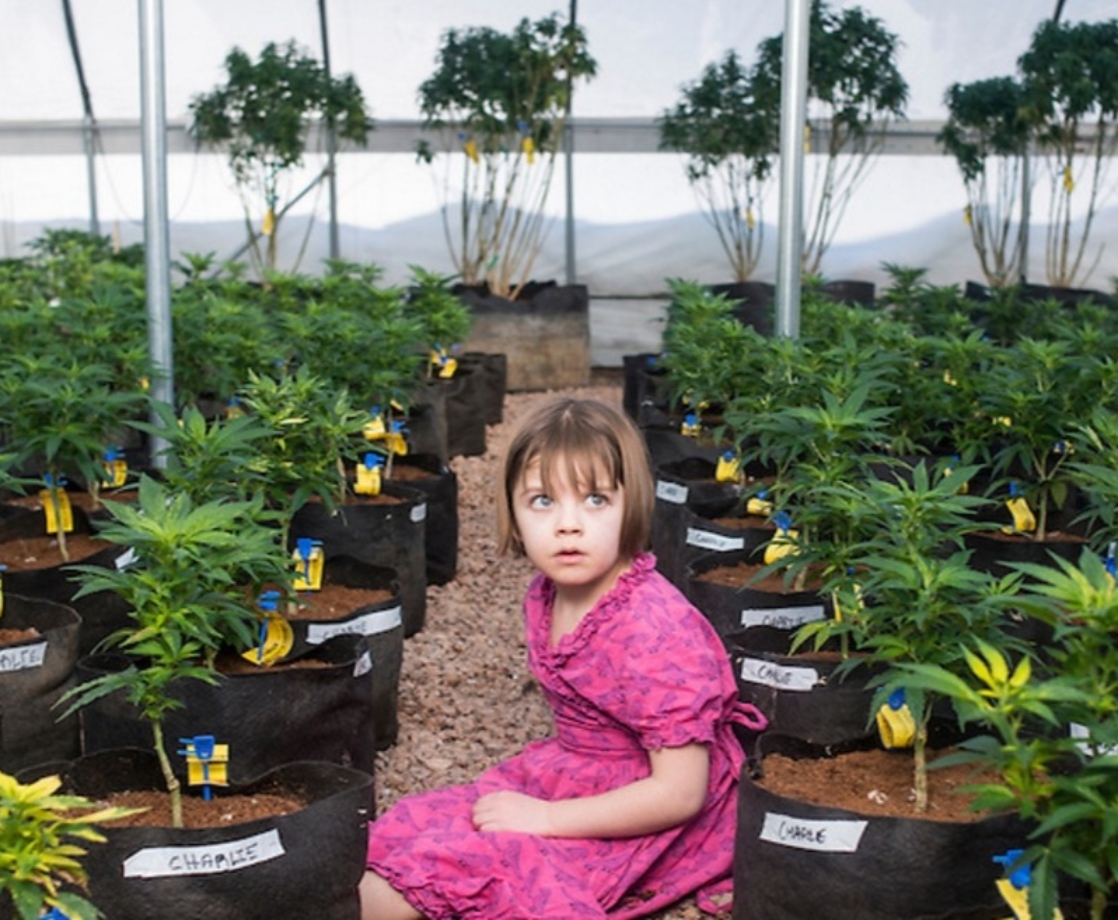
At age five, Charlotte Figi was having three hundred seizures a week (average about one every 30 minutes) confined to a wheelchair and using a feeding tube as swallowing was difficult for her. Her frequent seizures represented a response to a rare form of epilepsy called Dravet Syndrome. After Charlotte tested positive for the gene mutation, SCN1A, a common mutation in Dravet Syndrome, Charlotte’s mother, Paige Figi found relief in an answer. Unfortunately, her daughter was still having seizures and there was no way of treating them even with this discovery. Dr. Margaret Seed agreed to meet with the family to discuss the use of CBD, a nontoxic, nonpsychotic part of the cannabis list.
When weighing the options of Charlotte’s medical history and whether to use the CBD,
“The choice was easy,” states Seed. Working with the Stanley Brothers, who owned the biggest dispensary in the state, they were able to use the strain of CBD that was not selling due to its low potency (Young, 2013). Instead of getting rid of it, they used the strain to change Charlotte’s life. Under the doctor’s supervision, Charlotte started using the oil that came from the low-potent strain, and after years of uncontrollable seizures, Charlotte started making eye contact, walking, and eventually talking. She rode her bike, and most importantly, her seizures dropped to two to three times a month, mainly while she slept. Later, the Stanley Brothers would name it Charlotte’s Web (www.stanleybrothers.com, 2021) after young Charlotte.
The use of marijuana for medicinal purposes has initiated debate regarding the positive effects of monitored treatment and the intent of others to utilize its influence for non-medicinal purposes. Cases represented in research materials depict positive results of using marijuana to help treat conditions like cancer, HIV, neurological disorders, inflammatory pain, and autoimmune diseases (Azcarate, et al., 2020). In other reporting, people expressed negative reactions to allowing this method of treatment to become available to everyone (“More medicinal cannabis research needed,” 2019). Arguments exist to suggest banning the drug use for medicinal purposes or personal use because it can lead to other problems such as psychological disorders and addiction. As state governments continue to evaluate data for and against the legalization of medicinal marijuana use, the ability to effectively initiate a common decision remains a continued argument.
Pros
Marijuana is referred to as cannabis because of its makeup from the Cannabis sativa plant (Anderson, 2020). It is known for its mind-altering components and acts as a psychotropic drug affecting emotions, behavior, and thought processes. Made of elements of THC, users smoke the drug in the form of rolled cigarettes or pipes. The drug is found in edibles such as brownies, cookies, or extracts of the plant are chewed to expedite an inebriated state.
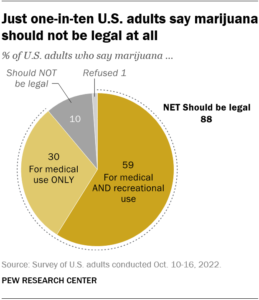
The growing legalization of marijuana has gained momentum in the United States over the last decade. In fact, two-thirds of those polled by Pew Research (Green, 2021) believe marijuana should be legal for recreational and/or medical purposes. As shown in Diagram A, 91% polled support legalization in various forms, with 60% believing it should be legal for both recreational and medical purposes, while thirty-one believe it should be legal for medical use only. While marijuana is still illegal on a federal level, eighteen states and the District of Columbia have legalized the use of marijuana, while thirty-seven states have legalized marijuana for medicinal use.
Over the past few years, the use of marijuana has increased significantly among people of all ages, especially young adults between the ages of 18 and 25 (Camors, Chavez, & Romi, 2020). Their support for legalization outweighs the support of those in the older generation (70% of 18–29-year-olds are for legalizing, while 32% of those surveyed seventy-five and older, believe in the legalization of the drug).
The use of medical marijuana is not new. The Shennong Ben Cao Jing, a Chinese encyclopedia on agriculture and medicine, has the oldest written record of cannabis as a medicine (Ding and Wang, 2015). Usage ranged from constipation, rheumatic pain, female reproductive tract disorders, and malaria. With wine, it also served as anesthesia during surgery.
Those who have used marijuana have said they are able to sleep better than before, have few side effects that mimic opioids, find their quality-of-life increases the nature of cannabis, and people are able to use as fit and perform their everyday tasks. Not only was medical marijuana common in China, but the US had it part of its drug pharmacopeia until 1943. During World War I, supply decreased, so American farmers started to grow their own east of the Mississippi, about 60,000 pounds annually, helping the US become less dependent on India. While politics, religion, and increased production of NASIDs saw the decline and in the inevitable schedule one classification of marijuana, the American Medical Association opposed the Marihuana Tax and supported studies for pain management (Procon.org, 2021).
Moreover, medical research for marijuana use has grown over the last decade. People living with chronic pain have found maintenance relief and the ability to do their day-to-day tasks without side effects (Carr and Schatman, 2019). Those dealing with trembles from Parkinson’s Disease also found relief from the plant. Veterans returning from combat have expressed marijuana has allowed them to manage their PTSD (post-traumatic stress disorder). Under doctor’s supervision, short-term studies have shown that marijuana usage has helped patients in their day-to-day life with less side effects than their pharmaceutical prescriptions.
Cons
Arguments exist against the use of marijuana and its impact on personal health and lifestyle. Met by opposition, viewpoints on the illegal use of the drug are slowly changing (www.samsha.gov, 2021). The marijuana market is escalating and the formulation of the cannabis plant into an edible or smokable form has changed from the development of a harmless product for a quick high, to a product that sometimes is immersed with external chemicals (Caulkins, 2018). This poses a risk to users who are attempting to remedy chronic pain or intake the drug socially. Remanufacturing the potency of marijuana by adding other compounds could increase the addiction rate, while diminishing the medicinal effects.
Examples of negative effects of marijuana include brain function, mental health, performance, personal health, and addiction (Moore, 2021; Carr & Schatman, 2019). Table A depicts the proposed negative impact of marijuana use. For those taking CBD, there may be complications or/and side effects users may not be aware of. In varying circumstances, people may experience nausea, fatigue, or irritability while others may experience more extreme side effects such as blood thinning, or an abnormal read of liver enzymes.
Negative Impacts of Marijuana Use
|
Negative Impact |
Description |
|
Brain Function |
Marijuana can contribute to IQ loss of eight points when used at an early age (www.samsha.gov, 2021). |
|
Mental Health |
The use of marijuana can lead to depression, anxiety, suicidal tendencies, and psychosis (www.samsha.gov, 2021). |
|
Performance |
Marijuana use can affect timing, movement, and coordination (Moore, 2021). |
|
Personal Health |
The use of marijuana can harm expectant mothers and leave a lasting effect on newborn babies (More medicinal cannabis research needed, 2019). |
|
Addiction |
Research on marijuana found few reports on the actual addiction rates. It is estimated that 1-in-6 people who use the drug at an early age could become addicted (More medicinal cannabis research needed, 2019). |
Regulation of CBD and low-grade THC also plays a factor in the effects of those wanting a temporary relief. With an escalation of marijuana stores, cannabis fields, and personal home harvesting of the drug, making marijuana sales a fast-growing industry, with online sales becoming an alternative method to sell the drug nationally and internationally, it is easy to buy a product that may be considered “junk” since it is not regulated by the FDA. Currently, CBD is sold as a supplement versus a medication, which leaves the responsibility to the consumer to research where they are purchasing CBD and marijuana products from, in hopes that companies are true to their word at the time of purchase.
Conclusion
Medical marijuana will remain a hot button topic for decades to come. Supporters of legalization of the drug express that marijuana is the answer to their prayers. However, others argue that marijuana is the cause of the downfall of our society. While marijuana, like most drugs, can lead to addiction and unpleasant side effects, there is also growing research that patients using marijuana as treatment for pain, insomnia, and certain behavioral disorders are finding relief that could not be found in their previous pharmaceutical prescriptions. As a supporter of legalization of marijuana for medicinal purposes, it is mandatory for individuals to understand both the pros and cons of marijuana use. If science stays at the center of research, the bias of marijuana can fade into the shadows as discoveries of benefits can be fairly compared to the harms that have been circulated. Instead of looking at marijuana usage like the plot of Refer Madness, we can think of Charlotte Figi, whose life was prolonged because of cannabis.
1 Charlotte Figi passed away from complications due to COVID-19, April 7, 2020.
References
Anonymous (2019). More medicinal cannabis research needed. Retrieved from https://www.proquest.com/scholarly-journals/more-medicinal-cannabis-research-needed/.
Anderson, P. L. (2020). Blue smoke and seers: Measuring latent demand for cannabis products in a partially criminalized market. Business Economics, 55(1), 26-40. http://dx.doi.org/10.1057/s11369-019-00159-y
Camors, C., Chavez, S. L., & Romi, A. M. (2020). The cannabis industry within the USA: The influence of gender on cannabis policy and sales. Sustainability Accounting, Management and Policy Journal, 11(6), 1095-1126. http://dx.doi.org/10.1108/SAMPJ-12-2018-0330
Carr, D., M.D., & Schatman, M., PhD. (2019). Cannabis for chronic pain: Not ready for prime time. American Journal of Public Health, 109(1), 50. http://dx.doi.org/10.2105/AJPH.2018.304593
Caulkins, J. P., PhD. (2018). Advertising restrictions on cannabis products for nonmedical use: Necessary but not sufficient? American Journal of Public Health, 108(1), 19-21. http://dx.doi.org/10.2105/AJPH.2017.304199
Ding H, & Wang Z. (2015, January). Experience of treatment and understanding of impediment disease in Shennong ben caojing. Zhonghua Yi Shi Za Zhi, 45(1):3-6.
Green, T. V. (2021, April 16). Americans overwhelmingly say marijuana should be legal for recreational or medical use. Pew Research Center. Retrieved December 7, 2021 from https://www.pewresearch.org/fact-tank/2021/04/16/americans-overwhelmingly-say-marijuana-should-be-legal-for-recreational-or-medical-use/.
Moore, T. E. (2021). MARIJUANA its effect on workplace safety. Professional Safety, 66(2), 34-39. Retrieved from https://www.proquest.com/scholarly-journals/marijuana-effect-on-workplace-safety/.
Procon.org (2021). Historical Timeline: Medical Marijuana. Retrieved December 7, 2021 from https://medicalmarijuana.procon.org/historical-timeline/#1900-1949.
U.S. Department of Health and Human Services (2020). Know the Risks of Marijuana. Retrieved from https://www.samsha.gov/marijuana.
Yeoh, P. (2020). Legal challenges for the cannabis industry. Journal of Money Laundering Control, 23(2), 327-340. http://dx.doi.org/10.1108/JMLC-06-2019-0049
Young, S. (2013, August 7). Marijuana stops child’s severe seizures. CNN. Retrieved December 7, 2021 from https://www.cnn.com/2013/08/07/health/charlotte-child-medical-marijuana/index.html.
Related Articles
Related
The Brain: A Complex, Ever-Evolving Organ
John Nash, a Nobel Prize-winning mathematician made major contributions to various aspects of mathematics and economics, including game theory, algebraic geometry, differential geometry, and partial differential equations. Aside from his intelligence, one notable...
Being Asexual: Is Love Without Sex Possible?
Staring across the room, the person who makes your heart beat a mile a minute catches your eye. Gathering your nerves, you walk up to them and start to talk. No one is perfect but you believe this person is. You have so much in common, it’s almost like it was meant to...
Be in the KNOW: Protecting Yourself from HIV
Human immunodeficiency virus, commonly known as HIV, is a virus that attacks the immune system. If not caught in time, HIV can develop into acquired immunodeficiency syndrome also known as AIDS, causing the immune system to fail at protecting the body from various...